It was collaboration.
The Opportunity
At Meta, posts helped teams share progress and priorities. But preparing weekly updates meant piecing together information from calendars, documents, and conversations—time taken away from the work itself.
Rather than introduce another communication tool, I chose to use AI to make participating in Meta's existing posting culture easier.
We had the tools to communicate. Participation still took work.
From Scattered Work to Shared Understanding
I designed a Claude- and MCP-powered workflow that synthesized existing work context into structured weekly updates.
Individuals could then refine the message, verify references, and decide what to share.
Less effort to communicate. More opportunity to connect.

Inputs
Calendars, tasks, documents, and collaborators provide work context.


Claude + MCP
AI synthesizes context into structured updates with relevant references.

Human review
People refine the message, verify details, and approve sharing.

Post
A shared post keeps teammates informed, aligned, and connected.
What the system produced
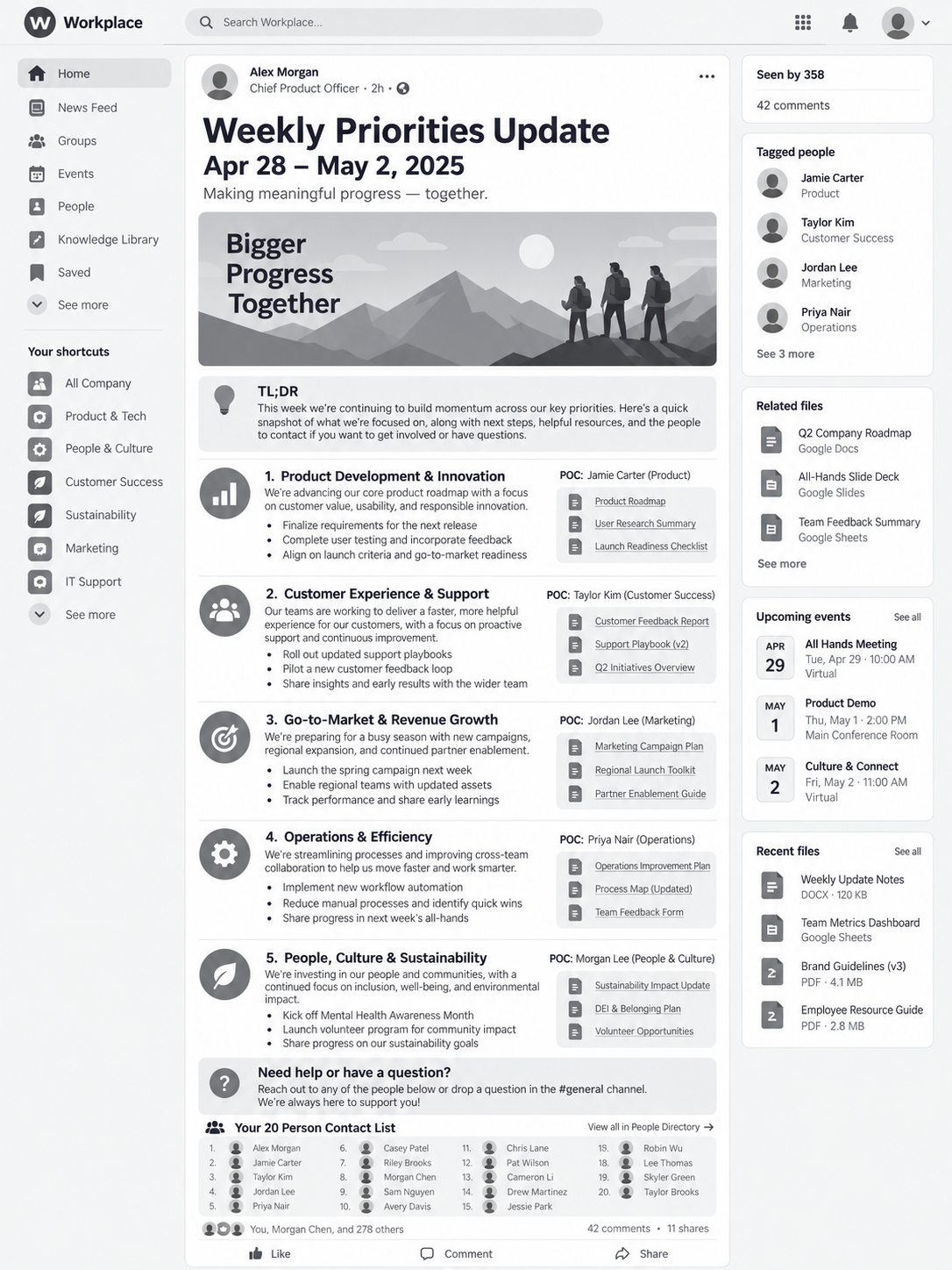
Each update combined a weekly synopsis, workstream priorities, supporting documents, and relevant collaborators in a format colleagues could quickly scan.

Weekly Tasks & Priorities
Apr 21 - Apr 25 2026


TL;DR
Product Delivery
• Resolved accessibility feedback.
• Prepared designs for engineering handoff.
Research & Feedback
• Identified three recurring usability issues.
• Prioritized improvements for the next iteration.
Team Alignment
• Resolved outstanding design dependencies.
• Coordinated next steps across teams.
Future Priorities
• Review prototype updates with stakeholders.
• Complete design QA and
handoff documentation.
Related links

Spinbot Design Handoff Checklist (Doc)
Project Key Usability Report (Doc)
Tagged collaborators

Alex Rivera
Jordan Jon
Priya Nair
Adoption & Impact
What began as a design-team workflow spread to engineering, product management, and research—without a formal mandate.
In my experience, weekly updates went from roughly 45 minutes of preparation to 5 minutes with AI, including review and edits—an estimated 89% time savings.
Built for designers. Useful beyond design.
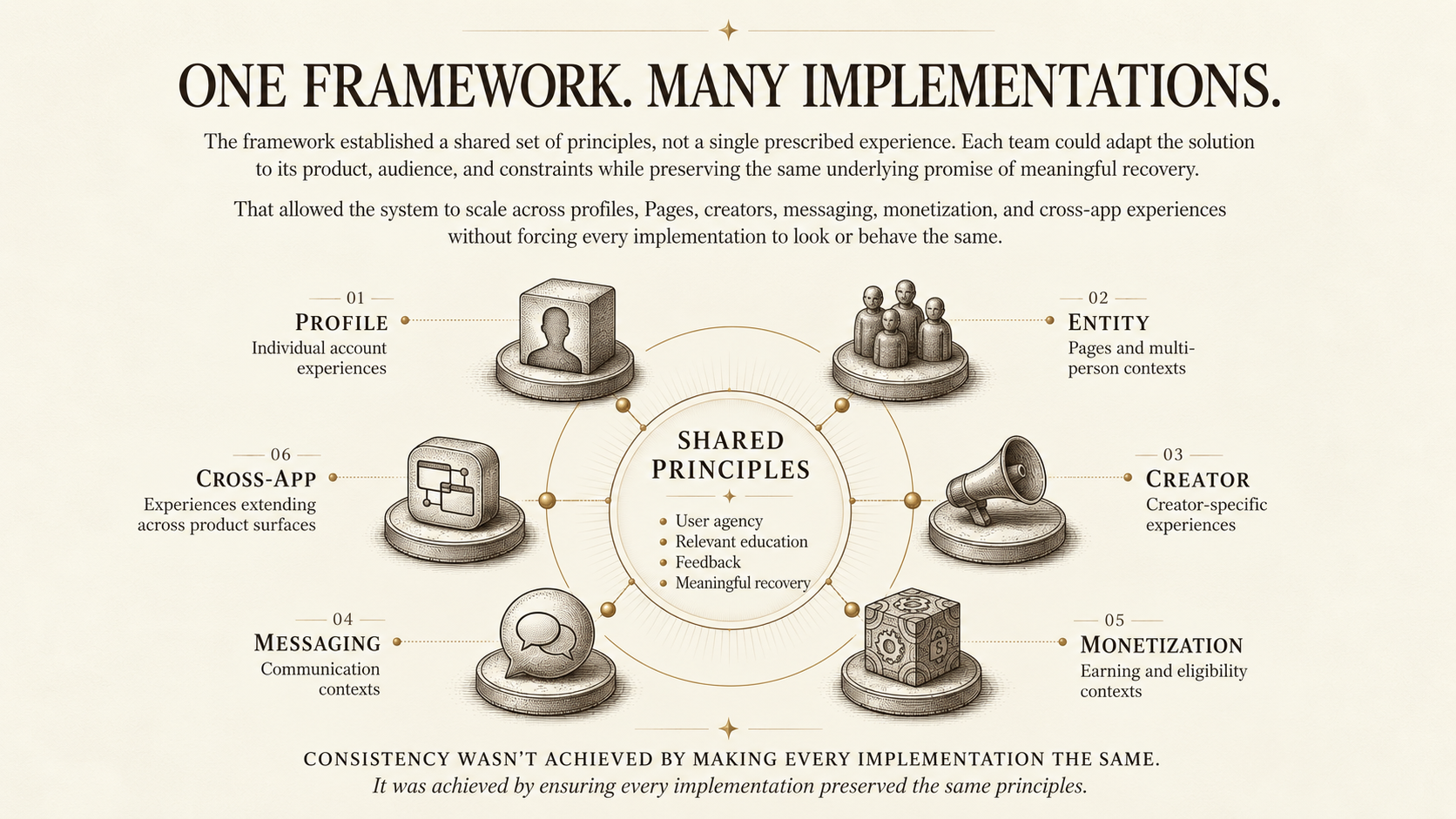
One Framework. Many Implementations
sasa
Making the Framework Transferable
Scaling beyond the original team meant making experience standards actionable across products and organizations.
A reusable experience template, cross-functional alignment, and ongoing design leadership helped translate those standards into new implementations—without compromising the experience's core.

Reusable experience template
Codified required elements and allowable variations across products, policies, and entities.
Expansion leadership
Directed conceptual design, cross-functional alignment, research validation, and execution.
Executive alignment
Co-defined the strategic narrative that helped resolve launch barriers, including for Instagram.
Responsible expansion delivered measurable value.
What I Carried Forward
Leading the experience from MVP through subsequent refinements taught me to balance customer needs, business priorities, and technical constraints without losing sight of usability.
That perspective shaped how I approach product challenges today: establish direction, make deliberate tradeoffs, and use evidence to continually improve the experience.
A useful product isn't defined by how much it can do, but by how confidently people can use it.
Technology can make communication easier without necessarily bringing people closer together.
This experience reinforced my belief that AI should do more than accelerate tasks. It should reduce the friction that prevents people from participating and connecting.


