wasn't policy. It was understanding.
Observation
Meta's initial approach was to make policies simpler and easier to find. But simplifying information wasn't the same as making people receptive to it.
I saw a different opportunity: people were most motivated to understand a rule when its consequences became personal.
I advocated bringing education directly into the enforcement experience—turning a moment of consequence into an opportunity for understanding and behavior change
From Insight to Product Direction
Making education part of enforcement challenged established assumptions about how the platform should respond to violations.
I developed the product vision and aligned Product, Policy, Legal, Engineering, Research, and Integrity around a new direction that balanced understanding, accountability, and recovery.
ORGANIZATION
CRITICAL PRIORITY
PRODUCT DECISION



Competing priorities. One viable direction.
A more effective approach to guidance and recovery
I brought education directly into the enforcement experience, turning a moment of consequence into an opportunity to understand the rules and take meaningful steps toward recovery.


THE OLD MODEL
THE NEW MODEL
Design focus
THE SHIFT DELIVERED
A more effective approach to guidance and recovery
I brought education directly into the enforcement experience, turning a moment of consequence into an opportunity to understand the rules and take meaningful steps toward recovery.

THE SHIFT DELIVERED
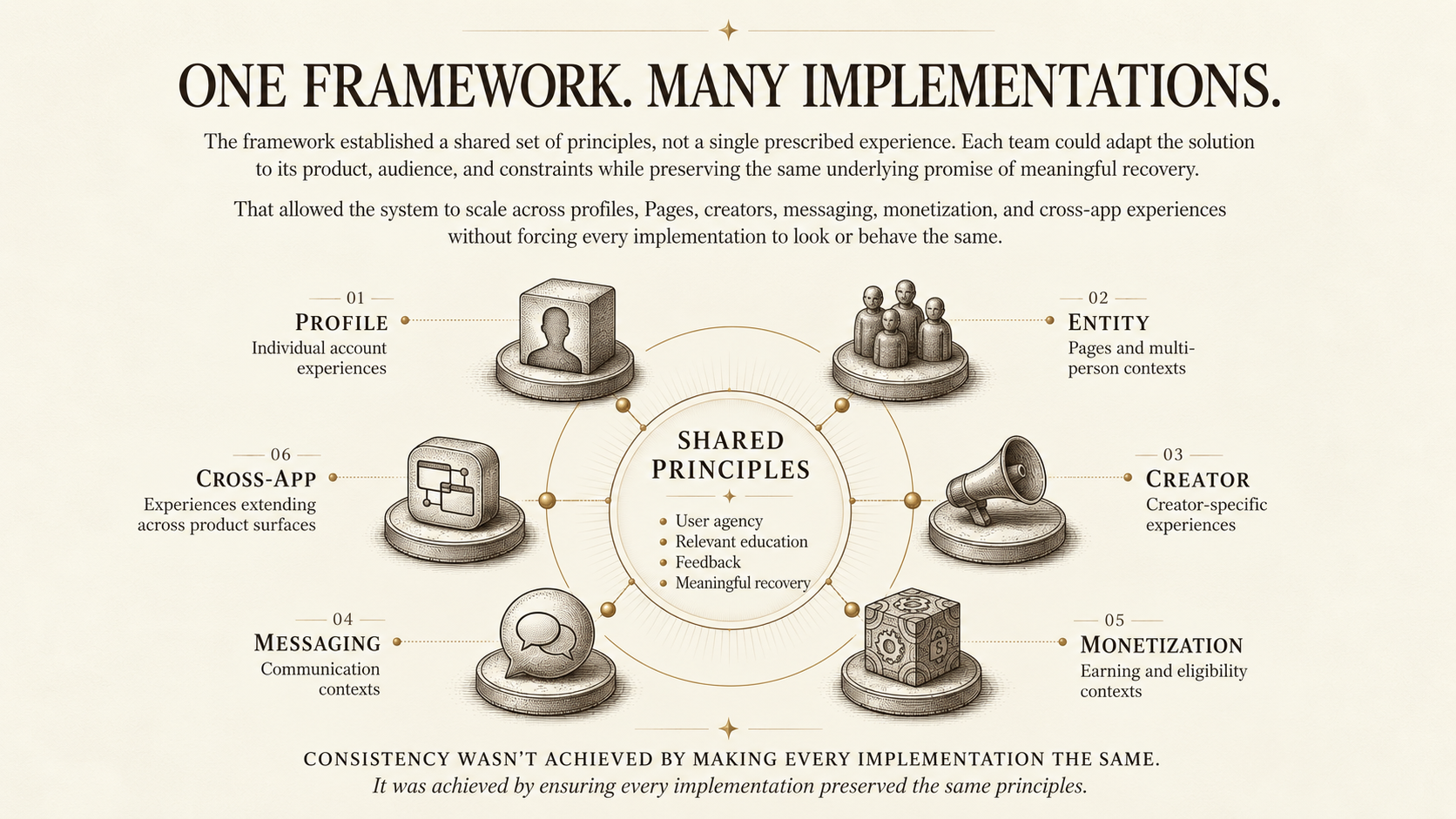
One Framework. Many Implementations
Across eight implementations, enforcement education needed to serve different account types, policy contexts, and recovery paths.
The experience requirements remained consistent. How teams implemented them could change.
Four decisions turned enforcement into an opportunity to learn.
Each decision translated behavioral insight into a product experience designed to help people understand their violations, learn the rules, and move forward.


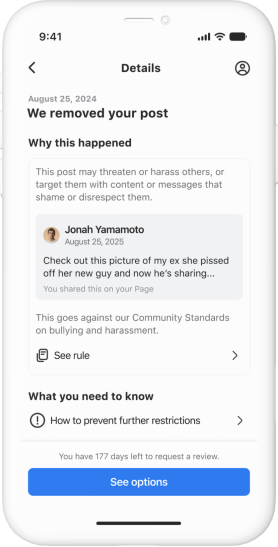
Timing Changed the Opportunity
People were most motivated to learn when enforcement affected them. Policy education missed that moment. I saw a better way.
I brought education into enforcement, turning consequences into opportunities for understanding and recovery.

Education Couldn't Replace Appeal
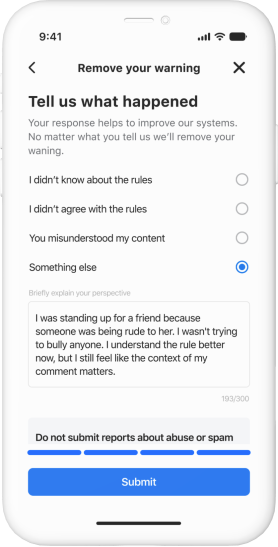
People needed more than explanations. They needed an opportunity to share how they understood an enforcement decision.
I incorporated feedback into recovery, creating a way to capture people's perspectives without affecting their eligibility for warning removal.
Clarity Before Commitment
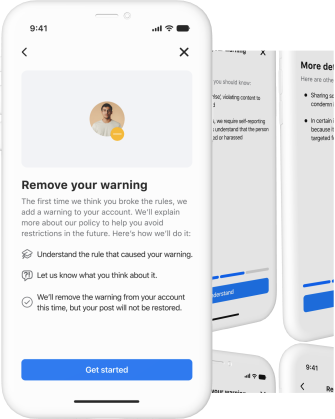
Asking people to learn required clear expectations and confidence in the recovery process.
I designed a guided education experience that made complex policies easier to understand and act upon.

Recovery Had to Lead Somewhere
Successful recovery created an opportunity to reconnect people with the platform—not just confirm a warning was removed.
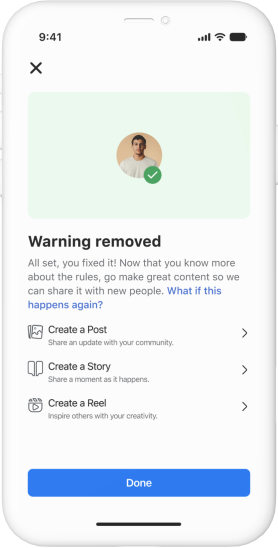
I proposed content-creation actions at completion, connecting recovery with renewed participation and broader goals.
From Hypothesis to Impact
The hypothesis was simple: helping people understand enforcement could change how they responded to it.
Launched across Facebook primary profiles, the experience made education-based warning removal potentially available at platform scale, subject to qualifying violations and enforcement history.
The results extended beyond education. People engaged with a new path to recovery, appeals workload decreased significantly, and the experience supported broader participation across Facebook.
Education created a new path. Recovery delivered broader value.

Improved Understanding
Rules perception improved 15%+, showing clearer understanding of enforcement.

Recovery was viable
Over 90% who opted in completed the experience; appeal workloads fell significantly.

Recovery drove use
It supported measurable growth in creator participation and output beyond recovery.
What the First Launch Made Possible
The initial experience addressed a specific enforcement problem, but its design logic extended beyond a single use case. By connecting consequences, education, and a clear path forward, I established an experience foundation that could support new policies and surfaces without starting from scratch.


Reusable Design Model
A consistent journey from understanding a consequence to taking meaningful action.

Designed for Adaptation
Core experience principles built to endure changes in policies, eligibility, and recovery paths.

Bridge to New Contexts
The shipped experience helped teams expand across enforcement policies and products.
Responsible expansion delivered measurable value.
In H1 2025, the global expansion of enforcement education to additional profiles reduced repeat violations and increased public connections—demonstrating that recovery and platform integrity could advance together.
From
Warning to Understanding
The original enforcement education experience gave people a new way to respond to their first strike—understand what happened, learn the rules, and remove an eligible warning.
Rather than ending with a consequence, the experience created a path toward informed action.

Explain the Violation

Choose a Path

Guided Learning

Return to Creating

Portfolio demonstration — This interactive prototype is independently hosted as part of my professional portfolio. It reflects a publicly released product experience whose design I led. The live product may have evolved since my involvement.
From Warning to Understanding
The original enforcement education experience gave people a new way to respond to their first strike—understand what happened, learn the rules, and remove an eligible warning.
Rather than ending with a consequence, the experience created a path toward informed action.
Explore how education became part of recovery.
Explain the Violation
Clear guidance helps people understand what happened and why.

Choose a Path
People can choose education or request a review while preserving their right to appeal.

Guided Learning
Clear steps and progress indicators make policy education easier to follow.

Return to Creating
Completion removes an eligible warning and opens the door to renewed participation.
What I Carried Forward
This work reinforced a belief I've carried across disciplines: understanding is the foundation of meaningful behavior change.
By challenging assumptions and aligning competing priorities, I helped transform enforcement from punishment into an opportunity for learning and recovery.
The lasting lesson: meaningful innovation begins by questioning the problem we're trying to solve.
Understanding doesn't just inform behavior. It changes it.


