wasn't scale. It was preserving intent
Observation
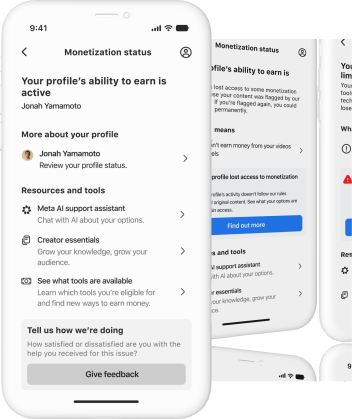
Enforcement education expanded from profile recommendation restrictions to Pages, warning removal, and monetization recovery—introducing new policies, entities, and consequences.
Each expansion brought different risks. Reusing the original experience unchanged could introduce unnecessary friction in one context and insufficient safeguards in another.
Strategic Direction
Before formal platformization, I led the experience decisions that made responsible expansion possible: preserving education and the right to request review while adapting recovery requirements to different levels of risk.
Working with Policy, I introduced stronger comprehension safeguards where the stakes warranted them—balancing user opportunity with platform integrity.
The Core Stayed. The Stakes Changed
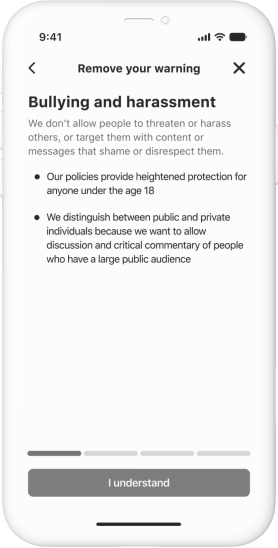
Warning removal required a lightweight educational path. Monetization recovery demanded stronger comprehension checks—two distinct experiences built around the same educational foundation.
Education before recovery
Relevant policy education remained central to the experience.

Lightweight completion
Eligible users could remove a warning after completing the education.

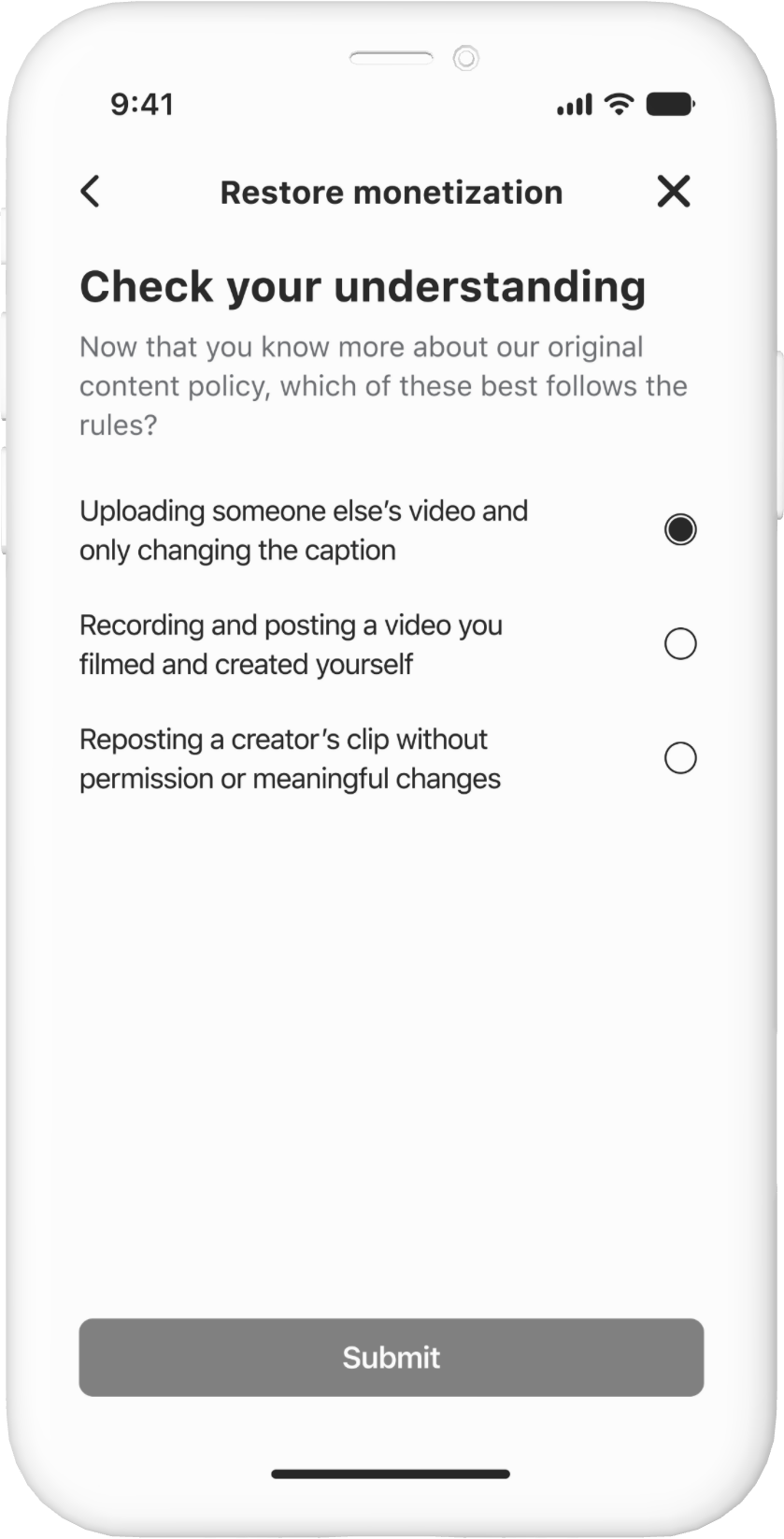
Deliberate friction
I introduced comprehension checks between educational steps, aligning the design with Policy.

Feedback, not failure
After submitting an answer, users received confirmation or corrective guidance. Incorrect answers didn't automatically end recovery.

The Core Stayed. The Stakes Changed.
Those decisions became distinct recovery paths—not a single flow reused across every consequence. Each preserved guided education while adapting what people needed to complete and what could be restored.
COMPARE
EXPERIENCE ELEMENT
LOWER STAKES

Strike recovery
A focused path to resolve an eligible warning or strike.
HIGHER STAKES

Restriction recovery
A tailored path to recover from specific restrictions.
Education experience
✓ Core education and next steps
✓ Policy-specific education (e.g., eligibility, requirements, impact)
Comprehension check
— Not required
✓ Required for select higher-stakes outcomes
Recovery action
✓ Complete guided education experience
✓ Complete tailored education + required checks
Friction level
Low (streamlined and lightweight)
Higher (additional steps and validation)
Outcome
Eligible warning or strike removed; other restrictions may remain
Eligible restriction may be lifted; underlying strikes may remain
Education experience
Strike-level recovery
✓ Core education and next steps
Restriction-level recovery
✓ Policy-specific education (e.g., eligibility, requirements, impact)
Comprehension check
Strike-level recovery
— Not required
Restriction-level recovery
✓ Required for select higher-stakes outcomes
Recovery action
Strike-level recovery
✓ Remove or resolve the strike
Restriction-level recovery
✓ Restore access or change an enforcement status
Friction level
Strike-level recovery
Low (streamlined and lightweight)
Restriction-level recovery
Higher (additional steps and validation)
Outcome
Strike-level recovery
Eligible strike removed; other restrictions may remain
Restriction-level recovery
Specific enforcement may be lifted; underlying strikes may remain
Strike-level recovery
✓ Core education and next steps
Restriction-level recovery
✓ Policy-specific education (e.g., eligibility, requirements, impact)
Strike-level recovery
— Not required
Restriction-level recovery
✓ Required for select higher-stakes outcomes
Strike-level recovery
✓ Remove or resolve the strike
Restriction-level recovery
✓ Restore access or change an enforcement status
Strike-level recovery
Low (streamlined and lightweight)
Restriction-level recovery
Higher (additional steps and validation)
Strike-level recovery
Eligible strike removed; other restrictions may remain
Restriction-level recovery
Specific enforcement may be lifted; underlying strikes may remain

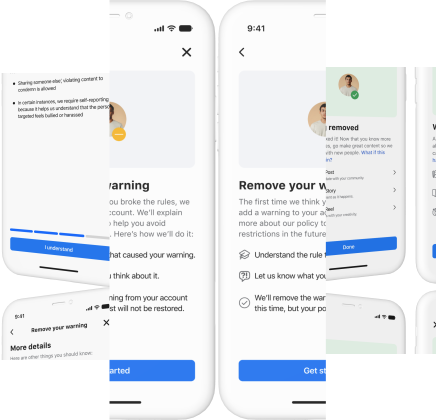
What stayed consistent
The educational foundation established in the original MVP carried forward into strike- and restriction-level recovery.
Guided learning
Acknowledge & recover
Path back to creating

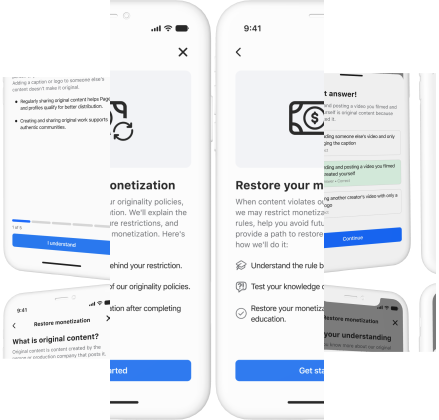
What changed
The same foundation gained deeper education, stronger safeguards, and additional requirements where the stakes demanded them.
Policy-specific education
Stronger validation
Higher-friction recovery
From Experience Decisions to Shared Standards
Early expansion surfaced recurring design decisions across policies, entities, and consequences. Within the broader platformization effort, I translated those decisions into explicit experience requirements—separating what every implementation had to preserve from what could adapt to context.
Experience decisions came first. Standards made them reusable.
Experience invariants
Defined essential requirements for agency, education, and recovery.
Permitted adaptations
Allowed policy content, eligibility, and recovery paths to vary.
Risk-based safeguards
Established where stronger checks and protections were warranted.
Design rationale
Documented the reasoning behind decisions for adopting teams.
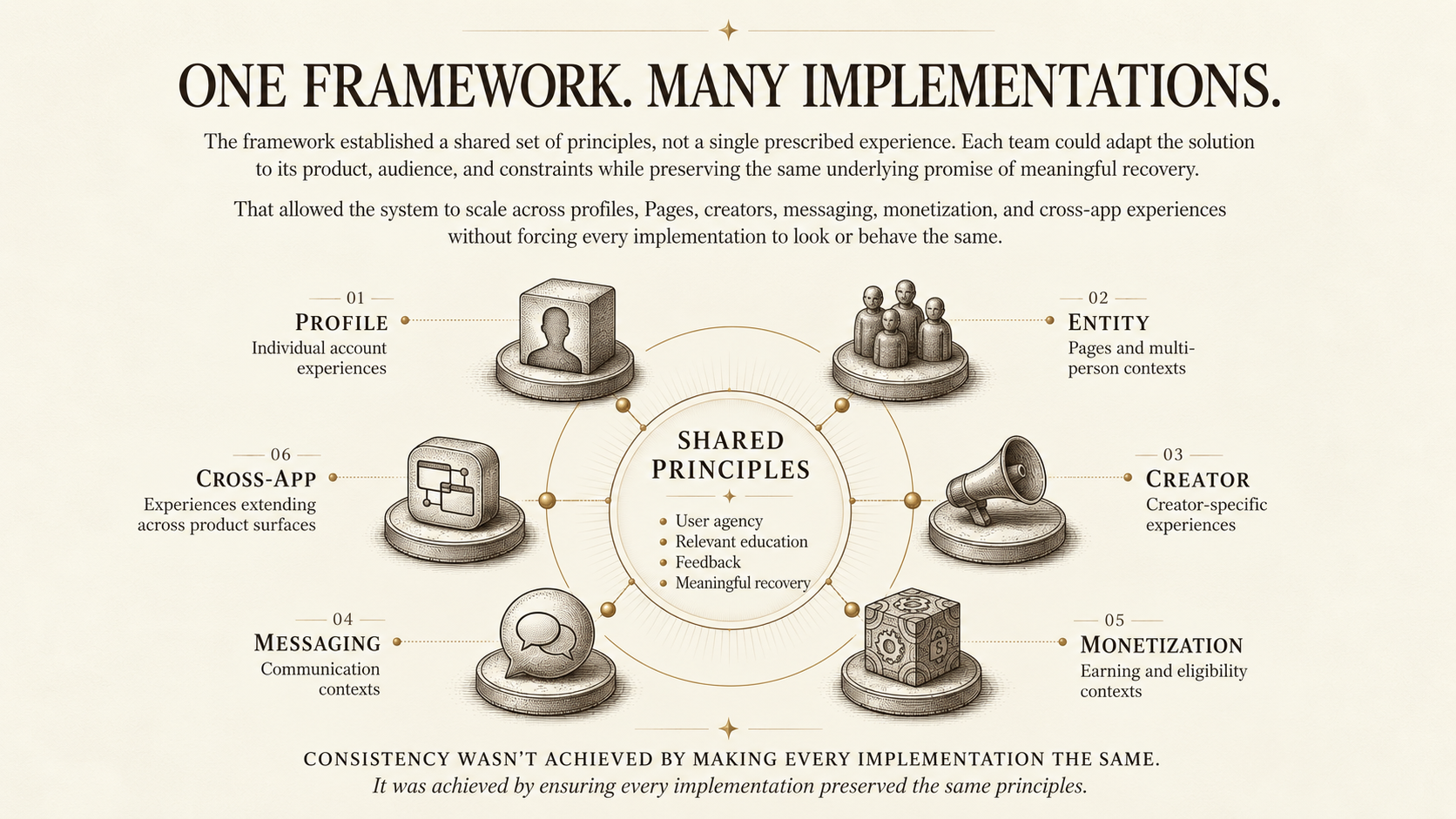
One Framework. Many Implementations
Across eight implementations, enforcement education needed to serve different account types, policy contexts, and recovery paths.
The experience requirements remained consistent. How teams implemented them could change.
sasa
Four decisions kept the experience effective as it scaled.
Each decision set a boundary: what people could challenge, what they needed to learn, how understanding was assessed, and what recovery could restore.


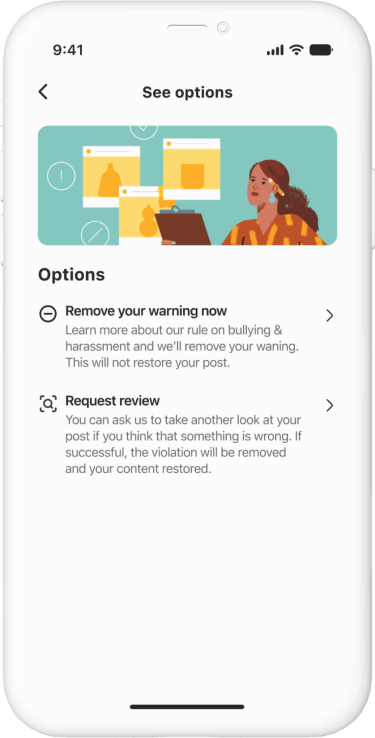
Agency Was Non-Negotiable
As recovery expanded, education could not become the only route for resolving an enforcement consequence.
I kept education and request-review as distinct options, preserving people's ability to challenge a decision.

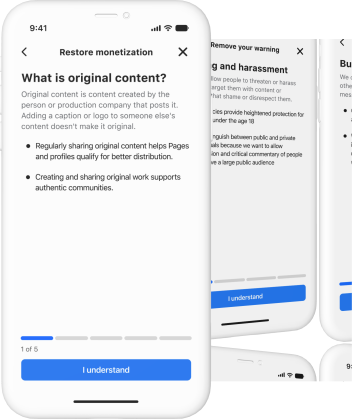
One Model, Different Policies
Different policies required different explanations, but not entirely separate learning experiences.
I made policy-specific guidance adaptable within a consistent educational structure.
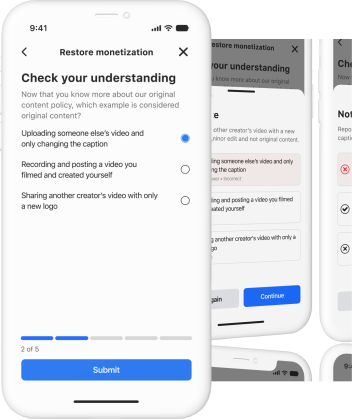
Comprehension Became a Safeguard
For select higher-stakes recovery scenarios, passive completion was insufficient.
Working with Policy, I introduced comprehension checks and corrective feedback to strengthen understanding without treating every mistake as automatic failure.
Recovery Matched the Stakes
Recovering from a restriction differed from removing a warning or strike.
I helped adapt recovery paths to restore specific privileges without assuming the underlying enforcement history was cleared.
From Experience Pattern to Team Practice
As enforcement education expanded across policies, products, and teams, a reference design alone couldn't ensure consistency. I turned experience standards into practical guidance, helping teams adapt the model without compromising its intent.

Experience Playbook
Documented key requirements, design rationale, and variations for new implementations.

Team Onboarding
Equipped teams with guidance to apply the experience consistently across use cases.

Implementation Reviews
Reviewed implementations, resolved inconsistencies, and upheld quality at scale.
Responsible expansion delivered measurable value.
In H1 2025, enforcement education expanded globally to additional profiles, guided by shared experience standards. The rollout saw fewer repeat violations and more public connections—evidence that recovery and platform integrity could advance together.
What Stayed Consistent Made Scale Possible
As enforcement education expanded across policies, products, and consequences, I preserved the essential experience requirements while adapting recovery to different levels of risk.

Clear context

Actionable guidance

Maintains integrity

A path forward

Portfolio demonstration — This interactive prototype is independently hosted as part of my professional portfolio. It reflects a publicly released product experience whose design I led. The live product may have evolved since my involvement.
What I Carried Forward
This work changed how I think about design leadership. Creating a successful experience is only the beginning. Scaling it means making the intent clear, defining what must remain true, and equipping others to make sound decisions as contexts evolve.
The lesson has stayed with me: lasting impact depends not only on the quality of a design, but on the judgment of the people who carry it forward.
Scale doesn’t preserve good ideas. People do.
The experience could adapt because the principles did not.
What Stayed Consistent Made Scale Possible
What began as a single recovery experience evolved into a flexible model spanning policies, products, and enforcement consequences. Its strength wasn't visual uniformity but the shared experience standards that held as the stakes changed.
Clear context
Explains what happened and why, using policy-relevant language the person can understand.
Actionable guidance
Provides clear next steps without exposing enforcement logic.
Maintains integrity
Education about the policy without teaching people how to game the system.

A path forward
Offers options to learn, request a review, and return to participation.


